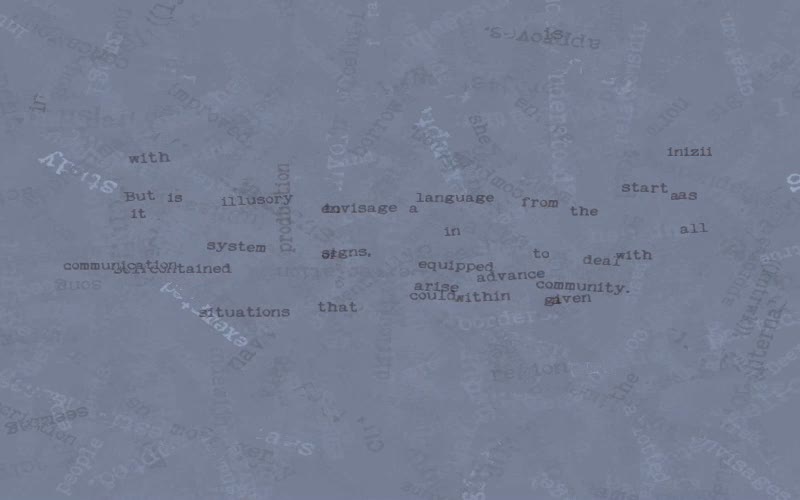
Dialectic Seepage
Takes two quotes, one by Noam Chomsky from the 1970’s at the height of the acceptance of his theory of universal grammar:
Language is a process of free creation, its laws and principles are fixed, but the manner in which the principles of generation are used is free and infinitely varied. Even the interpretation and use of words involves a process of free creation.
The other is by Roy Harris, the progenitor of Integrationism:
But it is illusory to envisage a language from the start as a self-contained system of signs, equipped in advance to deal with all communication situations that could arise within a given community.
Both quotes are highlighting the fluidity and versatility of language, but are deeply divided regarding the mental processes of language, Chomsky is declaring that although he views language in the mind as a symbol processing system (its laws and principals are fixed) but the meaning which we attach to words is not and we are free to use them as we will. This seems to me be a version of the Cartesian theatre of the mind or the strong AI position, the mind processes syntax, but meaning is ascribed in some other mysterious layer.
Harris on the other hand is taking a more literal view of the symbolist position, my interpretation is that language cannot be the result of a symbol-processing engine because it would be unable to adapt to new ideas and circumstances. There are flaws in this argument to, it denies the emergent possibilities within systems of formal language. Computer software is an example, based on a fixed system of signs, it is capable of expressing higher level abstractions not envisaged in the original design of the language.
In Dialectic Seepage I take these two opposing views on the fundamentals of language and subject them to a symbol processing system where the words and grammar are reduced to symbols, manipulated and reconstituted, to observe the semantic distortion. This is not quite ‘Chinese whispers’ as there is no communication from one mind to another, and so no process of interpretation, but is done through a process of ‘artificial intelligence’ mechanical syntactical translation of symbols. To do this I constructed a script that uses an existing program call libtrans to accesses existing Internet based translation services. My script determines which translations between languages are available and then constructs pathways between different languages. For example a pathway might be something like en – de – fr – en – ko - es – en (english to german to french to english to korean to spanish to english).
Each of the quotes is taken through a number of pathways of different lengths and then all the words collected and collated to form a collection of around 1000 words. The animation engine is based on the dynamics of damped springs for the foreground text and under damped springs for the background text, the animation is in three dimensions viewed from an orthographic perspective. The damped spring dynamics for the foreground text (the manipulated quotation) cause it to align and become readable, while the background text continues to move and pulse - a sea of latent meaning.
Language translation has been mechanised to the extent whereby the translations are intelligible but idiosyncratic, it reveals something of the underlying syntactical structure of different languages in a way that human based translation doesn’t, it also allows untranslatable concepts to ‘leak’ from one language to another, and meanings to drift and reform, like a variation of a literary “cut-up” technique. Dialectic Seepage is a dialectic engine, taking opposing opinions on the fundamentals of linguistic cognition and subjecting them to semantic torture to reveal a truth.