In the Guise of Thought
In the Guise of Thought is an installation consisting of a centrally suspended screen with high definition projections on either side and six channels of audio. Both the sound and imagery are software generated in realtime. It was first exhibited at CAST gallery in North Hobart, Tasmania in Feburary / March 2011.
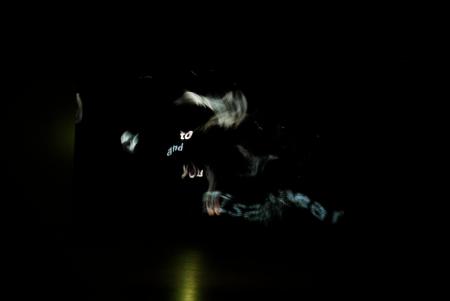
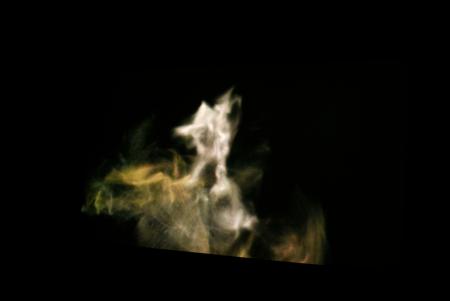
The dialogue between art, neural anatomy and philosophy of mind - theorising, exploring and reflecting on the nature of thought and thinking has been taking place for thousands of years. However this dialogue has intensified tremendously over thee past ten years, driven by new insights emerging from developing capabilities in neuro-imaging, digital simulation and the representation of animated and interactive dynamical systems.
Artist Statement
Art projects are often like trees, they can be rooted in many and various sources and inspiration, the artist ties these into a tangible bulk, and like the tree they extend into the world through a myriad of possible interpretations and experiences. You the viewer will take from this work what you will, as the artist I can only tell you something of the diverse obsessions, ideas, influences and experiments that led to it and what I was thinking as I made it. Together we make the experience.
In the Guise of Thought is crafted from customised software - it is a “software art” project, built upon software developed for scientific and engineering visualisation and runs on hardware developed primarily for computer gaming. It mixes rules and logic with carefully shaped randomness to construct a machine that is a bit like a lava lamp. The other component is the content; the sounds, images and text, which is sliced, shuffled and combined, to make a William Burroughs inspired “cut up” machine. It is not scripted, does not have a beginning, middle or end - it just is. I have chosen, edited or constructed the content, but much of it’s meaning comes from the chance relations that the elements make to each other. These are strategies that I have been employing in my work for some time, my ambition is to make art that encourages contemplative states of mind, that like clouds and flowing water - are constantly changing, never repeating, but in essence always the same.
In making this work I was thinking about representing processes of self-awareness and cognition (the processes of thinking). The title acknowledges that the work can’t think, it can only offer up a semblance of some aspects of thought. Working with computers, writing software, and exploring art, has led me into considering the mysteries of language, and the ways it operates. Language is like an invisible technology we all carry around with us, it is so effective that we only really think about it when it breaks down (and usually rather crossly). During the 20th C Noam Chomsky championed the idea, that no matter what language we speak, at the level of thought all languages are the same and somehow hardwired into the brain.While I admire Chomsky as a social activist and philosopher, I don’t subscribe to his views on language. In this view, the brain is like an immensely sophisticated computer, manipulating symbols in an internal language labeled “mentese”. When trying to express ideas through computer code though, its impossible not to be aware of how far the formal language of manipulating symbols (computer code) is from the natural language we use every day. Even the most precise and functional statement in English conveys meaning through a weight of ambiguity and implicit knowledge that is absent from even the most complex code.
(Video and Screen Capture documentation, click to play)
In recent years empirical evidence has emerged that suggests that language has a different relationship to thought, that different languages have different structures and concepts, the language you think in, definitely shapes how and what you can think about. Recent research suggests that for most people up to 80% of our thought is in words, that the way we use language influences our physical interactions with the world, for instance; if when you are looking for something, you mentally repeat its name to yourself, there is a measurable improvement in your ability to “spot” the object. So when thinking about representing internal language I visualised a seething sea of language, of vague and amorphous concepts forming and rippling, struggling to form or perceive a larger meaning. Thinking and communicating with words is an active process. The text for this part of the work comes from quotes about language, cognition and interior experience, which I have edited and added alternative expressions.
While making this work I read an extraordinary book written in the late 1970’s by maverick psychologist Julian Jaynes. Entitled “The emergence of consciousness in the breakdown of the bicameral mind”, Jaynes argues that the human mind has evolved, and that what we now think of as consciousness, the presence of an internal ‘I’, has only occurred in the last few thousand years. It is a fascinating book, along the way he provides explanations for war, religion, superstition, science and schizophrenia. In particular he talks of auditory hallucination as being commonplace in Neolithic society as the mind was not yet well integrated. In thinking about this I thought about the great weight of literature and represented experience we accumulate, the often-contradictory voices of wisdom and authority that we all carry around with us. The “voices” come from copyright free recordings of William Burroughs, Sylvia Plath, Dylan Thomas, Joanna Lumley, Timothy Leary, Laurie Anderson plus some other lesser-known figures.
The final element of the work depicts figures, objects and spaces shifting and forming in and out of focus in a void. A drone and regular beat from an electronic sruti box accompanies the work. The starting point for this component came when, looking for a way to computationally construct a three dimensional model from images, I found the work of Noah Snavely and Yasutaka Furukawa at the Graphics and Imaging laboratory part of the University of Washington. The idea motivating this software was to develop a cheap, low cost way to construct high quality models of architecture and archeology. Curious I downloaded the software they provided, built and tried it out. The software generates a “point cloud”, a cloud of coloured points in three dimensional space, generally this is seen as an intermediate stage towards the traditional polygonal model that we all recognise from computer games, animation and architecture. I was astounded by my initial test, the coloured points in 3D space formed dense clusters that didn’t have the instantly recognisable artificial quality of polygonal models. They reminded me in some way of late 19th C spirit photography. I’m certainly not the first artist to be using this technique, you may have for instance seen the Radiohead music video House of Cards from 2007 for instance.
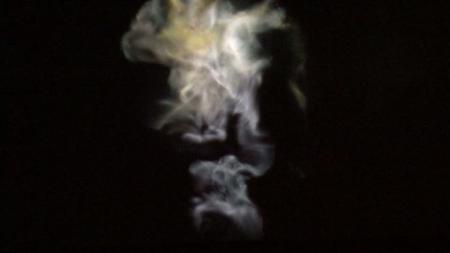
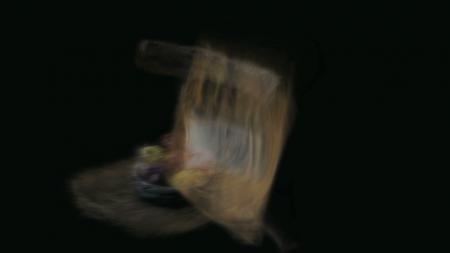
(Video and Screen Capture documentation, click to play)
One of the motivators for my art practice is the opportunity technological development provides to explore new modes of representation, and this new possibility of turning collections of images into point clouds, suggested a different approach to animation, animating hundreds of thousands of individual points in space, rather than a few thousand more complex objects as my earlier work had done. In making this image based component of the work I was thinking about the descent into sleep, the journey from wakeful consciousness through the hypnagogic state of splurging colours and gentle hallucinations to the extinction of conscious self awareness in the deep sleep state. The imagery comes from objects and people in my immediate family, and like mental images they fade and shift when looked at too closely.
Some final notes:
I have used almost exclusively open source software in this project. This is not for political, but for practical reasons. If you are unfamiliar with the concept, open source means that the source code of the software is published, and the authors have granted others the right to not only use, but also to modify the source code. Everything has a cost, and the cost of open source software is in time spent making it work, and the real prize is openness, being able to do whatever you want, being able to glue software objects from disparate projects together in ways that the original authors never would have thought of. In my opinion for this reason open source is the future of digital creativity.
I have written approximately 5000 lines of code across a dozen programs to create this work (and used millions of lines of code written by others). The computers are assembled from carefully selected parts, in the tradition of gamers and tweakers, they are not particularly special or expensive.
Making software art is not that different from any other art making process. Start with a vague and ill-defined idea, play and tweak, add parts in and take parts out, pause to reflect and consider. What is different I think, is the degree to which you have to be able to shift mental states from being numerate and analytic to verbal to visually focused. At times it feels like changing gears on a 1960’s sports car with a balky clutch.