The Electronic Image - object to picture
You’ve probably seen the adds for plasma screens, the glamorous young couple from the land of prada arranged on a minimalist couch in a cool room gazing at the huge vividly coloured flat screen. What are they doing, what are they looking at? It’s a bit disappointing if it’s just the footy.
This is a speculative presentation of some ideas that I have formed over the past five years, and while I’m not going to speak specifically about my current research activity these ideas have arisen out of ongoing practical experimentation.
My hypothesis is this, that after a long period of gestation and stability, the form and quality of the electronic image is undergoing a rapid transition: from object to picture. Simultaneously there is also a shift from verbal to visual literacy occurring in the primacy and organization of information. I speculate that together this will create a substantial shift in image culture, with a new mode of engagement with electronic images emerging – which I term ambient. These ambient electronic images will combine some of the qualities of traditional picture making with kinetic and temporal elements.
This shift will offer substantial research opportunities for both individuals and multidisciplinary research teams. An research idea will be put forward for which Tasmania would be an ideal location, with the necessary mix resources, stakeholders and expertise.
My research interests are driven by a fascination with the relationships between the evolution of imaging and communications technology and the human condition. How we image and augment our thoughts through technology becomes a core part of knowledge of the self. Technology is not an externally imposed entity placed into society; it has to be digestible. Technological developments do not occur through “linear progress”, but evolve through the multiple pressures imposed by social dynamics, economic resources and creative serendipity. Not many “inventions” succeed, but a few have profound impacts upon the way we know ourselves and know the world.
 While the electronic image has been the focus of intense experimentation and technological research for the past 100 years, much of that experimentation with novel imaging systems didn’t have a significant impact, in fact the dominant electronic imaging system - television was technically unchanged from 1950 - 2000. Its social impact was of course tremendous. But videophones, stereoscopic TV’s etc were never sufficiently appetising to be socially digested into the mainstream, whereas VCR’s and fax machines were… eventually. Indeed the early years of the introduction of colour televisions in the early 1950’s it was largely considered to be a commercial failure with little interest from the buying public. Sometimes it takes several iterations of technology for an idea to become successful.
During the past ten years the pixel processing power of consumer digital technology has become fast enough to compare to analogue television technology. Digital video editing has gone from being a high end cutting edge application of PC technology, to something that even the most basic of domestic computers can achieve. A characteristic of digital technology is its flexibility and adaptability, and consistent rate of increase in capability between successive generations of technology. Experiments in analogue high definition video began in the late 1940’s with the french and the Japanese in the 1970’s introducing working systems.
[1] But because of the difficulties in setting international standards and the inflexibility of analogue technology the wholesale adoption of high definition has only become a practical possibility in the past few years. When a digital technology develops a capability it tends to improve its capability very rapidly. Computer display systems now exist which have a far higher capacity than any moving image capture device; while 3D graphics cards are able to generate synthetic cinematic imagery at rates to match these displays.
My hypothesis is this: the electronic image is undergoing a rapid technological and economic evolution which will change the role of, and the way we relate to screen based imagery. Specifically:
- That the apparatus/cost of the electronic image is shrinking to the point whereby it will effectively disappear and become ubiquitous in the foreseeable future.
- Secondly that new modes of engagement with the electronic image will emerge, in particular ambient imagery. Ubiquitous imagery that will be a part of the personal or public environment, rather than competing to be the focus.
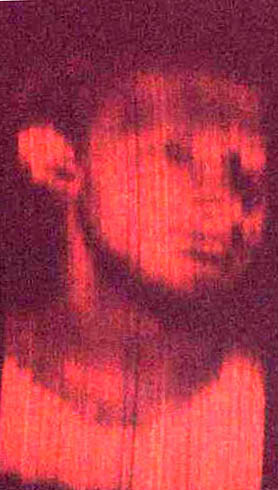
To explore the first point I’d like to do a brief visual tour of the history of the television. One of the things that first struck me when looking at John Logie Baird’s early mechanical TV’s from the late 1920’s besides how crude was the image
[3], was how small the image was, and how large the apparatus that contained it
[4]. I was reminded of my first experience of looking at QuickTime video on a computer in the early 1990’s, a tiny low frame rate postage stamp video, with a barely recognisable image. Beyond a curiosity who would take such a thing seriously enough to pay the equivalent of $12000 for one of the first, with the only chance to use it with experimental broadcasts of half an hour several times a week. It sounded a bit like an angle grinder too.
Throughout the twentieth century the electronic image was an object, sometimes disguised as household furniture, occasionally as a futuristic object. This object based nature, the poor quality of the image, the linear nature of television programming meant that the only way for the viewer to engage with the television is to develop the ability to focus and enter a trance like state of immersion. While the electronic image remains a flickering object it cannot be viewed as a picture.
I think that a similar argument can be made for engagement with cinema, which is why we tend to use filmic and televisual experience interchangeably. The apparatus of cinema is huge, the audience is contained with it, between the projector and the screen. It is a dark communal space, film is inherently a linear medium; passive immersion is the only possible response.
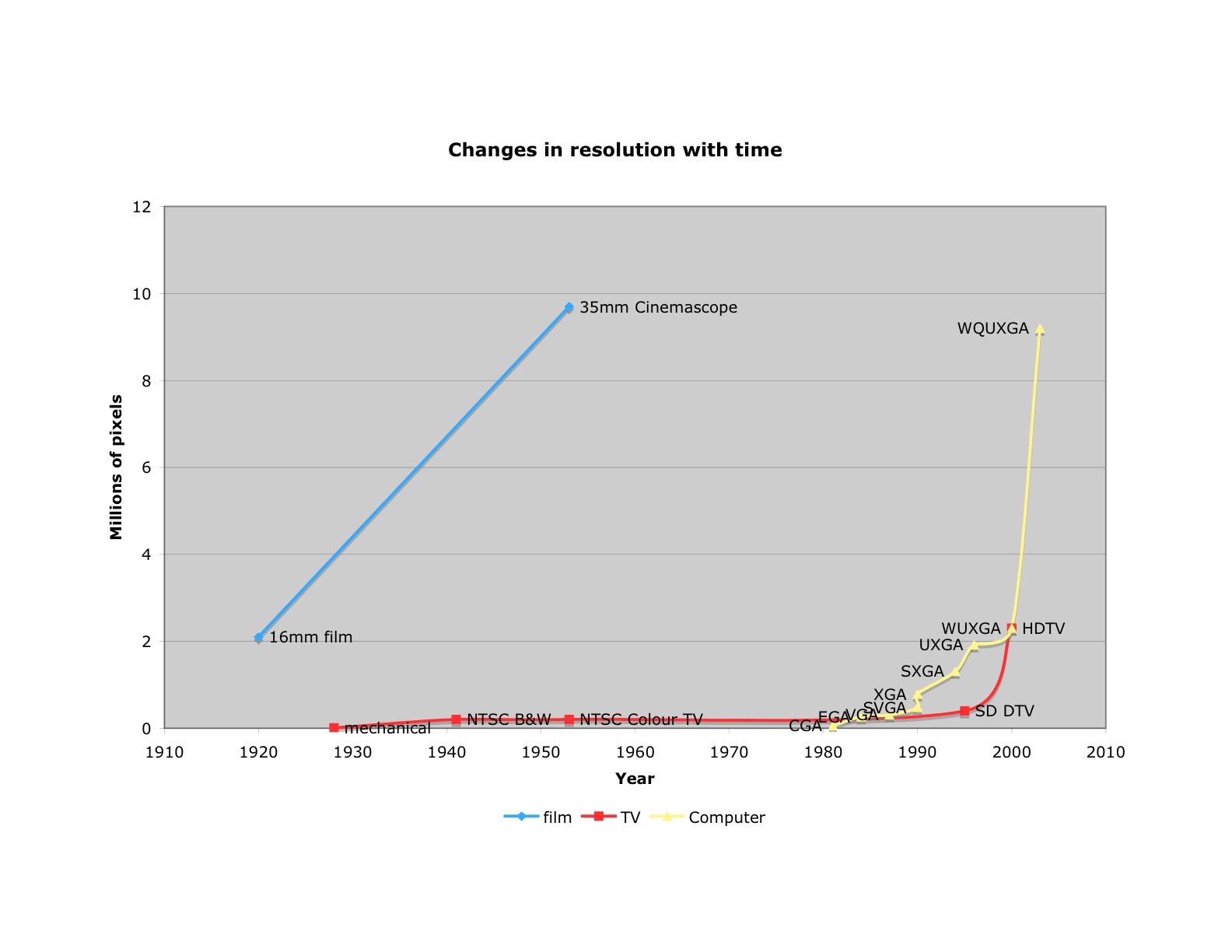 Looking at the graph of screen resolution against time
[5], it can be seen that the resolution of the electronic screen has started to develop very rapidly, with the highest resolution device available roughly equivalent to cinema by the early 2000’s. As important though as can be seen by the visual survey, the bulky apparatus of the electronic screen has shrunk to being little larger that the screen size itself. As the screen ceases to define the space around it through its objectness, cabling etc, it becomes more picture like.
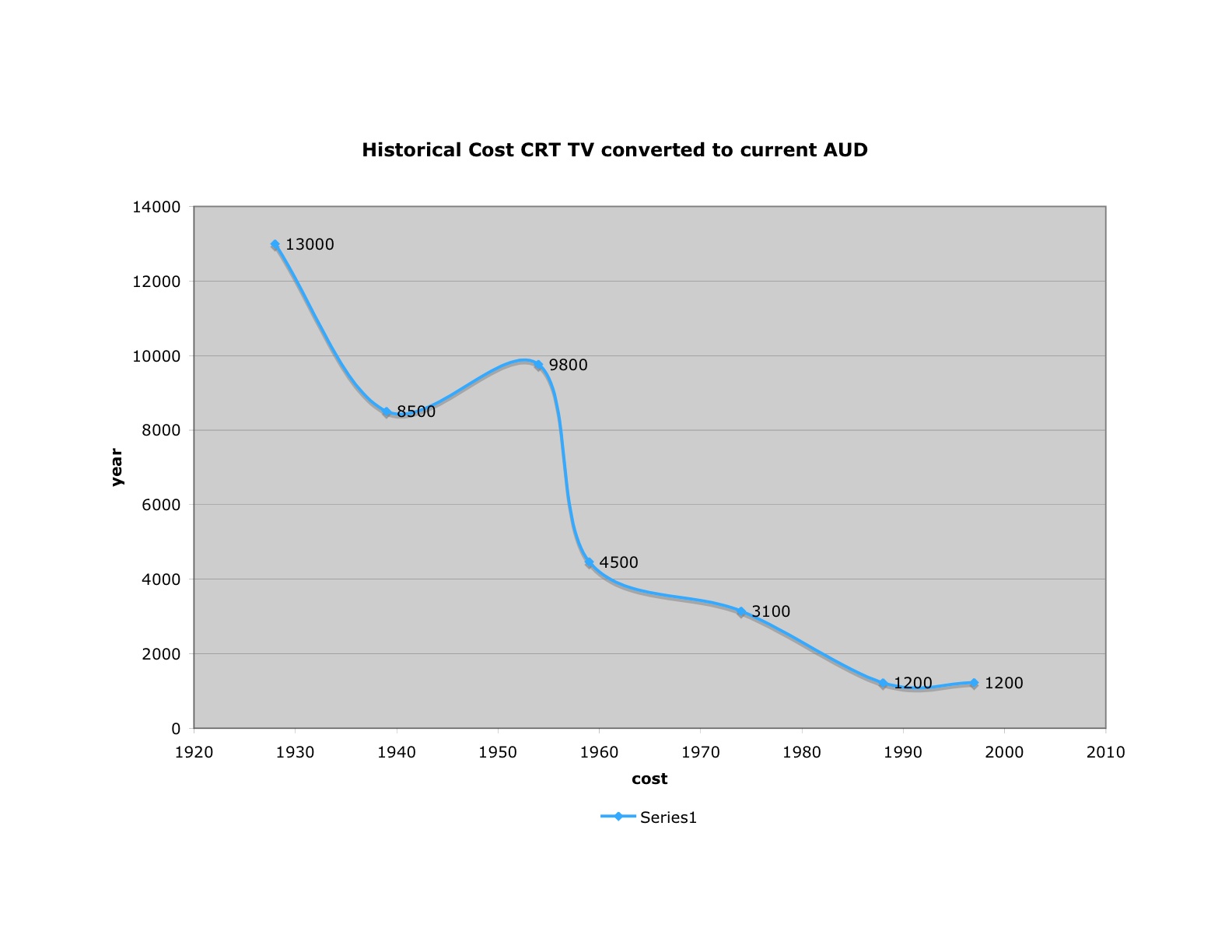 The second graph shows how the cost of CRT screens has dropped over time. The equivalent original cost of $10,000 for early TV’s is similar to the price payed for Plasma television screens a few years ago, which has now fallen to around a quarter of that price.
There is also technological arms race on between many of the major electronics multinationals to develop new generations of low cost flexible display mediums: electronic ink rivalling the readability of paper, roll up plastic displays, transparent displays, low cost, high fidelity large format thin displays.
One of the most disturbing products I have heard of under development was a cheap form of electronic ink that can print display circuits unto cheap paper/cardboard substrates to create animated packaging, which can flick between several different image states.
Returning to ideas of how we engage with electronic imagery originally, immersion was the dominant mode of engagement with film and television in the 20th century.
During the 1970’s electronic games opened up another mode of engagement: interaction. Perhaps more accurately described as active immersion, computer gaming has become a substantial cultural phenomenon. The economy of the online gaming worlds is already worth several billion dollars.
The development of the WWW during the mid 1990’s has lead to a different type of interactivity, and to a substantial shift in knowledge culture. The WWW has brought reading as a mainstream activity to the electronic image, however historical technology has made screen based reading an uncomfortable process, which has led to the activity of browsing, similar to magazine flipping, snippets of text, lots of images. What the WWW has changed is the way we organise and seek out information, illustrated by one of the most interesting of current trends: tagging.
One of the consequences of the change in the mode of engagement with information from book to screen is the change in organisational structure. From the taxonomic, a hierarchical tree like structure of authoritative classification to the folksonomic
[10]: a lateral rhizomic structure encouraged by idiosyncratic individual tagging. This also seems to be encouraging a shift from verbal to visual information exchange.
In this mode of engagement with the screen, you are not constantly immersed, you are free to move and redirect your attention to other aspects of your environment. The web by its very nature encourages a pluralist piecemeal approach to engagement.
One of the possibilities that interest me about the electronic image is its potential as an art form of the every day, rather than just in the privileged spaces of the gallery. One of the original frustrations and ambitions of early video artists was the inaccessibility of being able to engage through the medium of broadcast television with the public. The internet has to some extent in providing democratic access to electronic art, where the artist has made work accessible, and where the viewer can stumble across it if they look in the right direction.
Over the next 5 / 10/ 20 years it seems likely that large, low cost, flexible high quality electronic displays will be developed. They’ll be used as pictures or wallpaper or billboards. The computers to drive them will be built fairly invisibly into them; they may be networked and won’t have too many wires. They will be apart of our surroundings. Our engagement with them will be more casual than it currently is, constant immersion and competition for focus just wouldn’t work.
What interests me is what will people do with them? Will the social model still be to have one central screen, or will they be scattered about, will they be artworks to contemplate, part of the ambient atmosphere. Will they be abstract, figurative, loops, generative, synthetic… , will they be made for the gallery or the home. This possibility interests me because maybe it could lead to something new, a subtlety, and opportunity for contemplation, for surprise and enjoyment, some of the possibilities that the static image has, but with the potential for something else.
Here is an idea for an interdisciplinary research project based in these ideas, which would be ideal to conduct in Tasmania, combining expertise and interests in technology, art, environment.
What if, sitting anywhere in the urban world it was possible to have a live portal or picture window to anywhere else in the world, a moving picture that was part of the ambient environment, in a home, work space or public space.
At work you might subscribe to the storm channel, which displays high quality live imagery from a network of cameras that monitor storms that are happening around the world, at home an image in the bedroom displays a view port onto the Tarkine wilderness. On the way to work every day you pass through the train station, which contains a screen, focused on one of the few remaining breeding pairs of sea eagles, each day you see and note the development of the chicks.
Would people want to engage with this type of telematic imagery? Is it different to viewing a synthetic scene, or from a pre-recorded database of imagery. Could it generate a sense of connection to the world without the environmental costs of tourism? This wouldn’t be like a wild life program or film, it would be dull to watch all the time. But you wouldn’t be, it would be part of your ambient environment.
Most of the technology to do this either already exists or is in the process of being developed; initially it would be expensive, but eventually cheap and ubiquitous. It would require some engineering research to develop the necessary components:
- All weather housings for high definition cameras with solar power source and satellite or wireless uplinks
- Methodologies for installing and maintaining cameras in ecologically sensitive habitats
- Subscription mechanism and distribution network
But also considerable opportunities for research in the environmental, sociological and legal aspects. Such as:
- Can you set aside some areas purely for visual use and so reduce environmental pressures.
- Could you bring attention to environmental problems such as logging by providing a publicly availably feed.
- Could you reserve the rights to collect imagery from a particular location ?
The concept could be developed over time through a series of projects either as collaborative ventures, for specific applications or as specific public art projects.
[1] http://en.wikipedia.org/wiki/HDTV
[2] http://www.pcworld.com/news/article/0,aid,115676,00.asp
[3] http://www.tvhistory.tv/30line.jpg

[4] http://www.tvhistory.tv/1928-Baird-ModelC.JPG

Data sourced fromhttp://www.tvhistory.tv/, http://en.wikipedia.org/wiki/WQXGA
[6] Data sourced from http://www.tvhistory.tv/, currency conversion by http://futureboy.homeip.net/fsp/dollar.fsp
[7] For more information see http://www.eink.com/, http://en.wikipedia.org/wiki/OLED
[8] http://www.usa.siemens.com/index.jsp?sdc_p=fmlsuo1319922ni1309744pc194z3&sdc_sid=27100002008&