The Transient Taxonomies of Art
The content for this work is based on a web site developed by Robert Belton, called Words of Art I had been experimenting with force directed graphs, when I saw this web site and thought of it as an ontology, a rhizome of cross referenced terms. I had been pondering the idea of simulating an ecosystem of ideas, a visualisation of a ‘meme tank’. I had also been looking at the work of Nodebox Research, and the system they had developed using search engines as a reservoir of consensus knowledge about the world to assign colour and tone to a word.
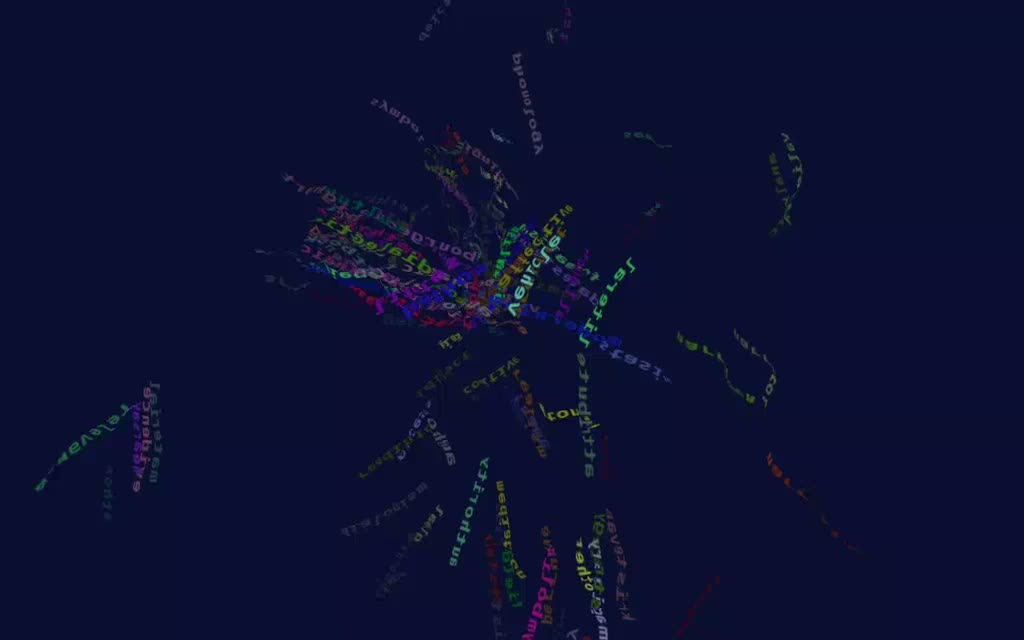
The Transient Taxonomies of Art uses the terms from Belton’s glossary of art terms, and assigns a colour and importance to them based on the yahoo search engine. The dynamics and interaction of the terms are based on a modified predator - prey flocking algorithm developed by Craig Reynolds. The work is displayed across a row of three monitors that give a perspectival view into the space of the simulation, in a similar manner to the viewing windows of a large commercial aquarium.
There is a level of irony to this work; I have come to the conclusion that the emergent behaviour of a flocking algorithm (a simple set of rules which generates group dynamics similar to flock birds or herds of animals), is similar to other mathematical complexity generators, essentially a formalism. In the title for the work transient is a synonym for emergent and taxonomy a referent to the hierarchal organisation of the original website and the classification of living forms. All artists who work with generative systems would like to create work that is truly open ended, that can with time increase its complexity, but while emergent algorithms such as flocking are useful and intriguing ways of generating group behaviour, but they are not of themselves, creative, no novel forms will emerge from it, the meaning in the work lies in the semantic associations we bring to it, the chance association of castration with lacanianism.