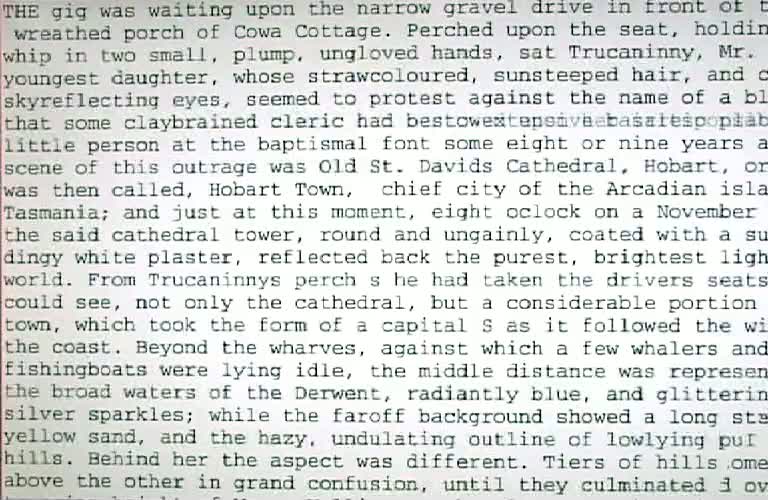
The writing machine (video documentation)
This is video documentation (shot with a video camera off screen rather than screen capture), of a project I worked on with Patrick Clancy called “The Writing Machine”. The Writing Machine was a concept developed by Pat, which in his words :
*The Writing Machine is a work-in-progress that will lead to an interactive installation and website. It combines meteorological sensor arrays, an interface incorporating a dynamic set of changing environmental conditions and human interaction with several real-time simulations. The primary material of The Writing Machine is an evolving stack of between 5 and 20 pages of text that are presented as orthographic projections. These texts are short personal histories and stories that individuals from around the world write in via the World Wide Web. The sequence of pages is altered according to atmospheric changes at the Banff Centre for the Arts in Alberta, Canada and my studio in Kansas City. New pages are generated and old pages are cycled to the layers below the surface where they function as memories or repressed experiences that erupt into the top or current page and are revealed according to the weather.
The Writing Machine project makes parallels between the weather of our planet and the forces at work in relationships among individuals, communities, telecommunication, and energy systems of all kinds. This work causes one to re-evaluate technology from more inclusive historical, ecological, psychical and social perspectives that emphasize the integration of nature and culture. All non-linear, dynamical systems exhibit varieties of weather. Non-linear generative processes present us with ways of experiencing and integrating different scales of information while also incorporating real-time interactive and collaborative events in our lives and art.*
I met Pat when he came to visit Tasmania to do a PhD examination. Given my interest in writing and previous experience with the weather I was quite interested in the writing machine, and the challenge of making it work. I looked around at quite a few different ways of doing what Pat described. I did a previsulaisation just called text to see if my ideas corresponded to what he was thinking of. I tried doing something similar in flash and then in director, before finally resorting to using C and OpenGL. I dusted off my rusty knowledge of C and C++ and after a fair bit of web searching came up with this program. We had a two week stint at a residency at the fabulous Banff Centre in Canada in which most of the work on this program was done. The software communicated in real time with a server connected to a weather station. We felt pretty good about it at the time, but unfortunately things unraveled a bit after that. Almost as soon as we left Banff, the weather server we had set up there stopped working, Pat lives in Kansas City and I live in Hobart, Tasmania so there were real problems with communication and collaboration. And some of the problems were also mine, my knowledge of OpenGL and C wasn’t at that time that extensive, and the project had some visual artefacts and stability problems that I wasn’t happy with but didn’t quite know how to fix. Also its hard to work on another artist’s project of this scale, your own ideas about directions to take it, or other work you want tod o tend to intrude.