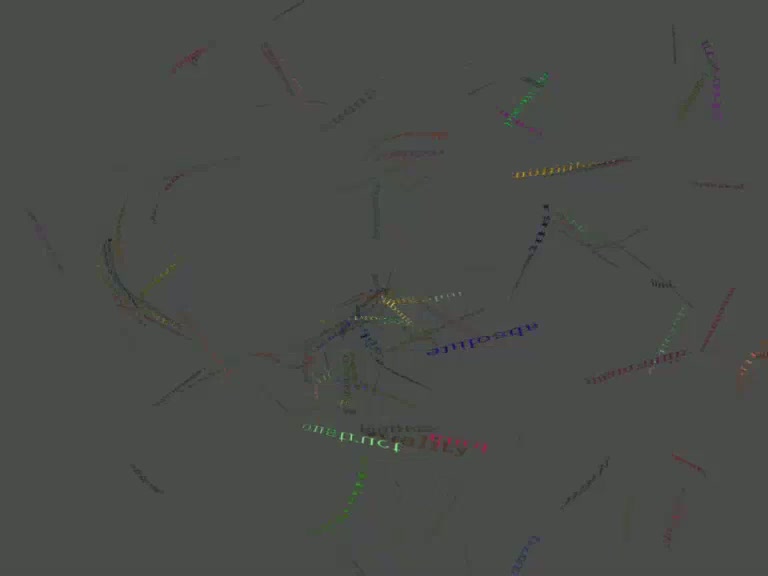
Words of Art v0.1
Documentation of an early version of words of art. I’ve constructed an ontology of art using as a source the ”words of art ” web site compiled by Robert Belton. I wrote a python script to extract the links from the pages and construct a linked list of terms. I then used the yahoo web api with python to write a script that determines some qualities of each of the terms (colour, hue, gravity “importance” etc) by counting the hits for proximity searches (how near a search word is to the key term). I used a similar approach to the “nodebox” people with their prism project, using yahoo rather than google as the search engine, because google requires soap and pysoap seems buggy and yahoo lets you do 5000 searches per day per IP whereas google only lets you do 1000 per license.
Next I looked at steering behaviours to for methods to give the terms behavious, like Craid Reynolds classic boids. I hit the jackpot and came across crogai by Nicolas Brodu. This software was built around a slightly older version of openscenegraph that the one I was using, but was fortunately pretty compatible, and quite extensive. I spent some time trying to figure out building python bindings for it, but decided in the end to go the other way and embed some python scripts into it and just modify some of the sample programs. Crogai used simple geometrical objects to represent individual entities, so I messed around with some of the ribbon objects I hade made, to make a “wriggler” object, a small tapeworm like surface which undulates as it “swims” along. I grafted this into the crogai c++ code. This is the result, with some manual steering through the simulation space. Like terms start off near each other, but occassionaly split off and join other groups.
Lots more fiddling required to resolve this. Some ideas/problems:
- entities tend to follow in lines, rather than bulk out. Need to look at proximity detection.
- documentation is way to fast (some timing problem). Simulation needs to be slower.
- Maybe add some fog to increase the sense of depth.
- More sophisticated interaction between entities, some exchange of energy or “gravity” to exert influence on other entities, changes in size/speed (?).
- Change in shape of space entities contained within (overlapping spheres of groups/populations)
- Like to show this on multi head monitors.