Tautologous
Tautologus was an exhibition of experimental digital prints held the S.P.A.C.E. Gallery Scotch Oakburn College Performing Arts Centre, Penquite Campus from 17th Feburary through to March 14th 2012. The catalogue / flyer attached gives a general description of the exhibition.
This body of work continues the line of enquiry and experimentation I have been exploring with digital imaging and printing for the last fifteen years. In particular using software processes to forming images from ‘marks’, i.e. words. This work is closer to I think therefore I am not sure if I am… than it is to the more recent prints in Gloss in that the text in each print is also a book.
The texts for the images come from the Project Gutenberg archive of copyright free etexts and include books by Jules Verne, Emily Bronte, Charles Darwin, Marcus Clarke, and slightly tounge in cheek, the 19th century educational theorist E.B. Stanley.
Constructing the prints involved a circuitous technical process, that evolved as the project developed. It started several years ago with a visit to Scotch Oakburn College as part of the Tasmanaian School of Art annual senior secondary school visits to provide course information to prospective students. The head of Visual and Performing Arts, Melissa Smith asked if I would exhibit some work in their S.P.A.C.E. gallery. I forgot about it for a year or so, but after developing the exhibition In the Guise of Thought last year where I used a photographic technique to capture point clouds. I started thinking that it would be interesting to further explore capture point cloud representations of people rather than objects of spaces. As the point cloud technique requires the subject / environment to be completely static while 20-50 photographs are taken, people are a challenge. Working with some students as both models and to capture images, we explored ways to take multiple simultaneous photographs.
In the middle of last year I spent two days with some students experimenting, some of these experiments worked, but many didn’t. I had originally intended to animate these point clouds, as I did in In the Guise of Thought but after considering the gallery space it seemed that prints would be more appropriate.
So the serendipitous process of making the images went something like this:
Firstly process the photo sets to generate the point clouds - started with about 70 sets of photographic images, about 20 generated some sort of point cloud. After looking through these about ten generated reasonably dense point clouds with something of interest.
Then I began to exploring and editing these further with the opensource software Meshlab got down to eight potential images.
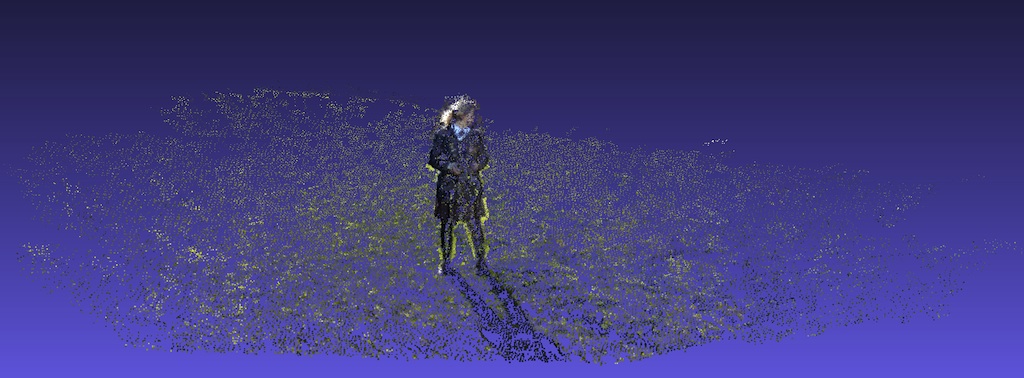
I started thinking about how the 3D (depth) information present in the point cloud could be used to render a print, in different ways to the approaches I had used in earlier work where information was sourced from a 2D image. One advantage is being able to recompose that image by being able to rotate, and change the viewing point of the point cloud gives great flexibility in being able to compose the final image. But there are also a range of possibilities in how the image is rendered, for instance; the marks (words) can be blurred with distance, or varied in size, or information from the point normals (which way they are facing) can be used to orientate the marks. I decided to seperate these aspects into two seperate processes, I wrote one peice of software to interactively compose the point cloud, and another to render it.
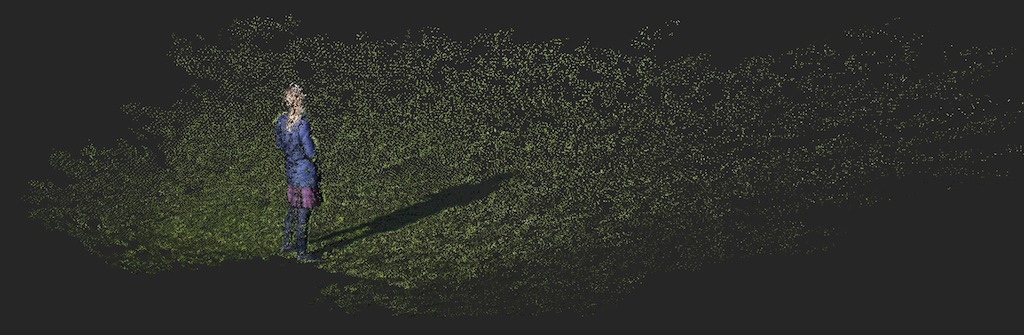
Each mark or word that makes up the images is rendered with some transparency. I do this to create a more complex image surface, but it also creates a greater apparent spatial and tonal resolution as marks overlap. I also wanted to create an artifical depth of field effect by blurring the marks based on their depth relative to a focal plane. So the process to render an image might be to open up the saved point cloud data from the composition program, sort the points via depth and then choose and render each point as a peice of text. For raniamtion, I use a package called OpenSceneGraph and I used this for the composition program, but it is not suitable for rendering high quality high resolution imagery. A animation screen image consists of around 2 million pixels, a large print of more than a hundred million. Even when you write your own software, you don’t write everything from scratch, you use other software libraries to do the actual rendering of text and layering of imagery. Finding the right library can take some time and experimentation. I found that bluring and layering semi transparent text correctly without ugly fringing artefacts is tricky. (A hint is to render the text firstly as a gray scale image, where the level of tone corresponds to transparency, blur it, then construct a colour image filled with colour, then copy the gray scale image to an alpha channel).
Finally after the technical problems are resolved, further aesthetic choices of an appropriate font to render the text with, and choice of an appropriate text, and a lot of iterative experimentation with tuning parameters, creating background layers of text, and figure / ground relationships. Each attempt may take the computer ten minutes up to three hours for several hundred thousand words.
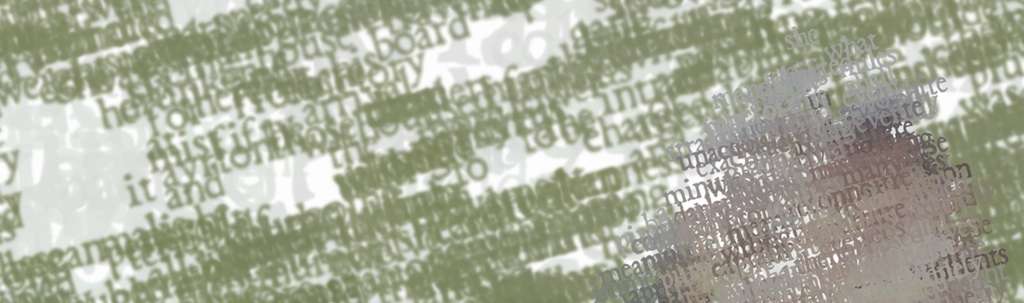
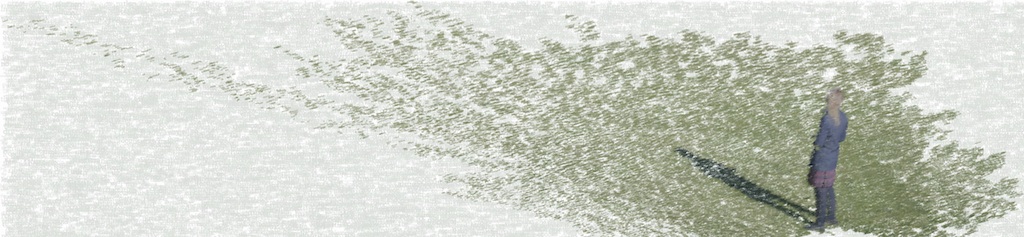
Final compositing of foreground and background layers, and tweaking of colour and transparency happens in Adobe Photoshop.

[tautologous catalogue.pdf](/media/archive/tautologous catalogue_1.pdf)